Hidden isolation
Not every student who needs support will ask for it.

Peng Wang
Director
May 14, 2026 / 8 min Read
Overview Some students who need wellbeing support are highly visible. Others are much easier to miss. They may not disrupt learning, disclose distress, or appear in incident reports. Instead, their risk may emerge quietly through social withdrawal, weak peer support, exclusion, loneliness, or gradual disengagement. Australian and international evidence shows that school connectedness, peer relationships, social inclusion, and support networks are closely linked to young people’s mental health, engagement, attendance, behaviour, and learning. AITSL notes that students with diminished school connectedness are more likely to experience poor health and wellbeing, elevated risk of anxiety and depression, lower achievement, and risk-taking behaviours. For school leaders and wellbeing teams, this creates a practical challenge: some students may need support before they are visible through conventional referral, behaviour, or attendance pathways. | Leadership questions · Who is quietly disconnected but not yet “on the radar”? · Which students lack trusted peer support? · Where might exclusion or loneliness be developing unseen? · Are we relying too much on visible behaviour as our main warning sign? · How can we detect hidden isolation before it escalates? |
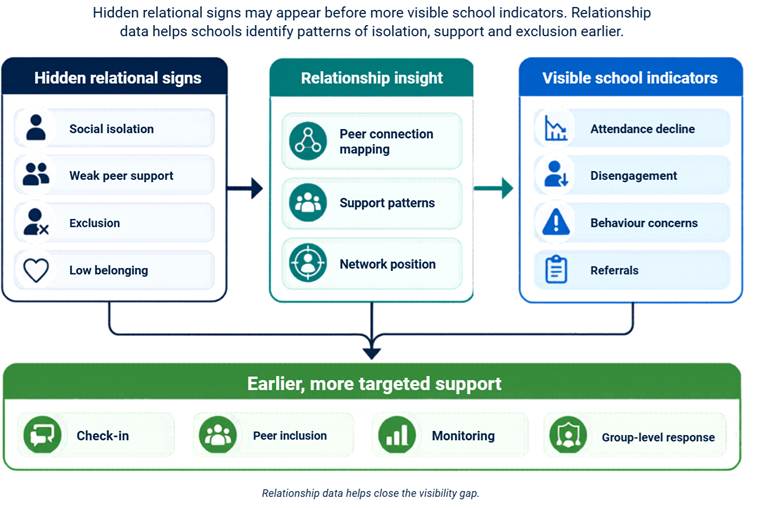
Figure 1. The visibility gap. Hidden relational signs such as isolation, weak peer support, exclusion, and low belonging may develop before students appear in attendance, behaviour, or referral data. Relationship data helps schools identify these patterns earlier and respond with more targeted support.
Why hidden isolation matters
Hidden isolation is not simply “having few friends”. It can take different forms:
| Form of hidden risk | What it may look like in school | Why it matters |
| Social isolation | A student has few or no meaningful peer connections. | They may have limited informal support when stress increases. |
| Low school connectedness | A student does not feel accepted, respected, included or supported. | Low connectedness is linked to poorer wellbeing, anxiety, depression and lower achievement. |
| Social exclusion | A student struggles to fit in, participate or access supportive relationships. | Australian youth survey evidence links social exclusion with poorer mental health and wellbeing. |
| Peer victimisation | A student experiences bullying, disrespect or negative peer treatment. | Peer victimisation is associated with worse adolescent mental health. |
| Weak support network | A student may know others but lack trusted peers they can rely on. | Friendship quality and support can matter more than simply the number of peers around them. |
This is why “quiet” students should not automatically be assumed to be “fine”. Some students are socially peripheral without being behaviourally visible.
What the evidence says
1. School connectedness is protective
AITSL defines connectedness and belonging as the extent to which learners feel accepted, respected, included and supported by others at school. AITSL notes that connection to school is associated with positive health and academic outcomes, while diminished school connectedness is linked with poor health and wellbeing, elevated risk of anxiety and depression, lower achievement and risk-taking behaviours.
School implication: Connectedness is not just a general wellbeing aspiration. It is a protective condition that schools can monitor and strengthen.
2. Social exclusion is common among Australian young people
Orygen and Mission Australia’s analysis of the 2022 Mission Australia Youth Survey found that 60% of 18,800 surveyed young people aged 15-19 had experienced social exclusion in the previous 12 months. These young people showed significantly poorer mental health and wellbeing than peers who were not socially excluded. Among young people experiencing relational difficulties, 62% reported high psychological distress, compared with 21% of those without relational difficulties. The report also found that 53% of young people with relational difficulties reported feeling lonely most of the time, compared with 17% of those without relational difficulties.
School implication: Social exclusion can be a substantial wellbeing risk, and relational difficulties may be strongly associated with psychological distress and loneliness.
3. School climate and peer relationships are linked to adolescent mental health
Long, Zucca and Sweeting’s study of 2,571 fifteen-year-old students in 22 Scottish secondary schools found that peer victimisation was associated with worse mental health, while school belonging, student-teacher relationships and perceived inclusive school climate were associated with better mental health.
School implication: Students’ mental health is shaped by both peer dynamics and wider school climate. Schools need to pay attention to belonging, inclusion, teacher relationships and peer treatment.
4. School connectedness is linked to depression and anxiety prevention
Raniti and colleagues’ systematic review found that most studies reported a significant protective relationship between higher levels of school connectedness and depressive and/or anxiety symptoms.
School implication: Strengthening school connectedness is relevant not only to engagement and culture, but also to mental health prevention.
5. Social network methods can help identify different forms of isolation
Recent social network research shows that adolescent social isolation is multifaceted. Peer nomination and social network analysis can identify different forms of social isolation, such as having no connections, receiving few nominations or sending nominations that are not reciprocated. These different patterns may reflect different social experiences and may have different implications for wellbeing.
School implication: A student’s social risk may not be visible from self-report alone. Relationship mapping can help schools see whether students are connected, peripheral, unsupported or disconnected in more nuanced ways.
Evidence Theme | What research shows | What this means for schools |
| School connectedness | AITSL links diminished connectedness with poorer wellbeing, anxiety/depression risk, lower achievement and risk-taking behaviours. | Connectedness is a protective factor schools can monitor. |
| Social exclusion | Orygen/Mission Australia found 60% of surveyed young people aged 15-19 experienced social exclusion in the prior 12 months. | Hidden exclusion is common and strongly linked to distress. |
| Relational difficulties | Young people with relational difficulties reported much higher psychological distress and loneliness. | Peer difficulties should be treated as wellbeing signals. |
| Peer victimisation and climate | Long et al. found peer victimisation was associated with worse mental health, while belonging and inclusive climate were associated with better mental health. | Mental health is shaped by peer dynamics and school climate. |
| Social network analysis | Network research shows isolation has different forms that can be detected through peer nomination data. | Relationship mapping adds insight that individual surveys may miss. |
| School connectedness | AITSL links diminished connectedness with poorer wellbeing, anxiety/depression risk, lower achievement and risk-taking behaviours. | Connectedness is a protective factor schools can monitor. |
Why relationship data adds value
Traditional wellbeing systems often rely on self-report surveys, teacher observations, attendance records, incident reports and referrals. These are valuable, but they may not always reveal whether a student is socially isolated, lacks trusted peer support, or is quietly excluded from the peer group.
Relationship data adds another layer. It helps schools understand who is well connected, who may be socially isolated, who has few reciprocated friendships, who is trusted or nominated by peers, where peer support is strong or weak, where negative peer dynamics may be concentrated, and which groups may need stronger belonging and inclusion support.
This matters because two students with similar wellbeing scores may have very different relational contexts. One may be isolated. Another may be embedded in a negative peer dynamic. Another may be supporting many others while needing support themselves.
How SNA Toolbox helps
SNA Toolbox helps schools combine student wellbeing data with peer-to-peer relationship mapping. This gives approved staff a clearer view of patterns that are difficult to detect from individual data alone.
The platform can help schools identify:
· students who may be socially isolated
· students who are peripheral to peer groups
· students with limited peer support
· friendship and support groups
· influential students and trusted peer connectors
· negative or disrespectful peer dynamics
· cohort-level patterns in belonging, support and risk
The aim is not to label students. The aim is to help schools see hidden relational patterns earlier, so support can be more targeted, proportionate and practical.
Practical implications
Not every student who needs support will ask for it. Some students become visible only after attendance drops, behaviour changes, conflict escalates or distress becomes harder to hide. A relational lens helps schools notice patterns of isolation, exclusion and weak support before concerns become more serious.
If wellbeing risk can be hidden in relationships, schools need relational insight to support students earlier.
Call to action
Request a consultation to spot hidden isolation earlier.
· See how peer connection data can help identify students on the edge of the group.
· Explore a clearer way to detect hidden risk before it escalates.
· Talk to SNA Toolbox about identifying isolation, peer support and belonging in your school.
References
Australian Institute for Teaching and School Leadership (AITSL). (2022). Wellbeing in Australian schools. https://www.aitsl.edu.au/research/spotlights/wellbeing-in-australian-schools
Orygen & Mission Australia. (2023). Social exclusion and the mental health of young people: Insights from the 2022 Mission Australia Youth Survey. https://orygen.org.au/About/News-And-Events/2023/Major-study-reveals-when-young-people-are-socially
Long, E., Zucca, C., & Sweeting, H. (2020). School climate, peer relationships, and adolescent mental health: A social ecological perspective. Youth & Society, 53(8), 1400-1415. https://doi.org/10.1177/0044118X20970232
Raniti, M., Rakesh, D., Patton, G. C., et al. (2022). The role of school connectedness in the prevention of youth depression and anxiety: A systematic review with youth consultation. BMC Public Health, 22, 2152. https://doi.org/10.1186/s12889-022-14364-6
Lester, K. J., Coleman, J. R. I., Roberts, S., Keers, R., Breen, G., & Eley, T. C. (2022). Impact of school and peer connectedness on adolescent mental health and well-being outcomes during the COVID-19 pandemic. International Journal of Environmental Research and Public Health, 19(11), 6768. https://doi.org/10.3390/ijerph19116768
Rothon, C., Head, J., Klineberg, E., & Stansfeld, S. (2011). Can social support protect bullied adolescents from adverse outcomes? A prospective study. Journal of Adolescence, 34(3), 579-588. https://doi.org/10.1016/j.adolescence.2010.02.007
Crudgington, H., & Andrews, J. L. (2025). Studying adolescent social isolation in school-based social networks. https://ora.ox.ac.uk/objects/uuid:0ba5e26b-8372-4366-84c7-72111b668bec
Tags:
Transform Your Organisation with SNA Toolbox
Unlock insights into the key factors driving success and wellbeing in your organisation. Reach out to us at SNA Toolbox to explore how we can support and elevate your goals. Let's make an impact together!