School culture lives in everyday student relationships
Culture is not only what schools say they value. It is what students experience every day.

Peng Wang
Director
May 20, 2026 / 6 min Read
Overview A positive school culture does not happen by chance. It is built through everyday relationships: how students treat one another, whether they feel included, whether they have trusted peers, whether they feel safe to participate, and whether the wider school climate supports belonging. Australian and international evidence consistently links school belonging, positive school climate, and connectedness with student wellbeing, engagement, behaviour, attendance, and learning outcomes. A meta-analysis of 82 studies found that students’ sense of school belonging is associated with motivational, social-emotional, behavioural, and academic outcomes in secondary education [1]. For school leaders, this means culture should not be treated as an abstract value. It is a relational condition that can be strengthened when schools have clearer insight into how students are connected, included, supported, and influenced. | Leadership questions Where is belonging strong, and where is it fragile? Are all students experiencing the culture we aim to create? Which peer groups are connected, excluded, or disconnected? Who are the informal student connectors shaping culture? Where should we focus action to strengthen belonging? |
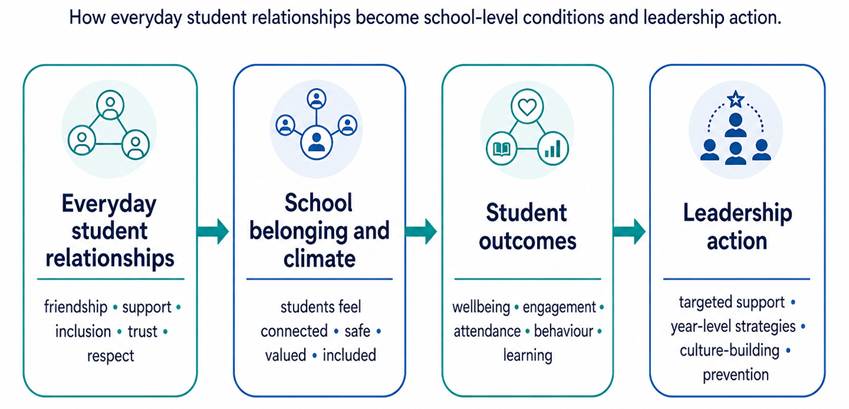
Figure 1. A simple pathway showing how everyday student relationships shape school belonging, student outcomes and leadership action.
Why this matters for school leaders
School leaders are often asked to improve culture, belonging, behaviour, engagement, and learning outcomes at the same time. These priorities are sometimes treated as separate problems, but the evidence suggests they are closely connected.
The Victorian Framework for Improving Student Outcomes 2.0 places learning and wellbeing together and describes five core elements for improving outcomes for every Victorian student. It also emphasises that, when integrated, these elements build a positive environment through strong relationships [3]. The Victorian Department of Education’s positive climate for learning evidence base describes positive learning climate as involving shared values, trust, high student motivation, professional teaching culture, and strong partnerships [4].
In practical terms, school culture becomes visible in questions such as:
· Which students feel connected and included?
· Which groups are socially cohesive but disconnected from others?
· Where are students isolated or excluded?
· Which students are informal peer leaders?
· Where might disrespect, bullying, or negative influence be concentrated?
· Which year levels, houses, classes, or cohorts need stronger belonging support?
This is where relationship data can help. It gives leaders a way to move from broad statements about culture to specific, actionable patterns.
What the evidence says
Evidence Theme | What research shows | What this means for schools |
| Belonging is linked to learning, behaviour and wellbeing | Korpershoek and colleagues’ meta-analysis found that school belonging is associated with students’ motivational, social-emotional, behavioural and academic functioning [1]. | Belonging should not be treated only as a wellbeing issue. It is part of the learning environment. |
| Positive school climate can protect wellbeing and engagement | Chen, Cárdenas, Zhou and Reynolds’ Australian longitudinal study found that positive school climate and strong school identification before COVID-19 were protective factors for adolescent mental health and learning engagement during disruption [2]. | A strong school culture can act as a resilience resource when students face disruption, stress or change. |
| School improvement frameworks connect culture, wellbeing and learning | FISO 2.0 supports excellence and equity through learning and wellbeing and highlights strong relationships as part of a positive environment [3]. | Culture, wellbeing and learning should be managed as connected priorities, not separate workstreams. |
| Positive learning climate includes trust, motivation and partnerships | Victorian evidence describes positive learning climate through shared values, trust, motivation, professional culture and strong partnerships [4]. | Leaders need visibility into whether these conditions are experienced by students. |
| Belonging varies across contexts | Chiu and colleagues’ cross-cultural study of 193,073 fifteen-year-old students across 41 countries found that students’ sense of belonging varied across cultural, family, school, teacher and student factors [5]. | Schools need local evidence about how students experience connection in their own community. |
Why relationship data adds value
Traditional culture measures often rely on staff perception, general climate surveys, behaviour data, attendance patterns, or student wellbeing surveys. These are useful, but they may not show the peer-level dynamics shaping students’ everyday experience.
Relationship data adds another layer by helping schools understand:
· who is connected and included
· who may be isolated or peripheral
· where friendship and support groups are forming
· which students are informal connectors or peer leaders
· where negative peer dynamics may be concentrated
· whether different parts of the cohort are socially integrated or fragmented
· where belonging may need targeted support
This matters because school culture is not experienced evenly. One year level, class, house, or peer group may feel highly connected, while another may be fragmented or affected by exclusion.
How SNA Toolbox helps
SNA Toolbox helps schools combine wellbeing data with peer relationship mapping so leaders can see the relational patterns shaping culture and belonging.
The platform can help approved school staff identify:
· friendship and support structures
· socially isolated or peripheral students
· peer connectors and informal student leaders
· negative or disrespectful peer dynamics
· cohort-level belonging and connection patterns
· year-level or group-level areas where culture may need support
The aim is not to label students or reduce culture to a graph. The aim is to give school leaders a clearer evidence base for strengthening belonging, improving support, and making culture-building more targeted and practical.
Practical implications
School culture is not only what schools promote. It is what students experience in everyday relationships.
If students feel included, connected, respected and supported, the conditions for wellbeing and learning are stronger. If students feel isolated, excluded, unsafe or disconnected, culture becomes a risk factor.
To strengthen school culture, schools need to understand the relationships through which culture is lived every day.
References
1. Korpershoek, H., Canrinus, E. T., Fokkens-Bruinsma, M., & de Boer, H. (2019). The relationships between school belonging and students’ motivational, social-emotional, behavioural, and academic outcomes in secondary education: A meta-analytic review. Research Papers in Education. https://doi.org/10.1080/02671522.2019.1615116
2. Chen, S., Cárdenas, D., Zhou, H., & Reynolds, K. J. (2024). Positive school climate and strong school identification as protective factors of adolescent mental health and learning engagement: A longitudinal investigation before and during COVID-19. Social Science & Medicine, 348, 116795. https://doi.org/10.1016/j.socscimed.2024.116795
3. Victorian Department of Education. (2024). Framework for Improving Student Outcomes (FISO 2.0): Policy. https://www2.education.vic.gov.au/pal/fiso/policy
4. Victorian Department of Education. School-wide Positive Behaviour Support https://www.vic.gov.au/school-wide-positive-behaviour-support
5. Chiu, M. M., Chow, B. W.-Y., McBride, C., & Mol, S. T. (2016). Students’ sense of belonging at school in 41 countries: Cross-cultural variability. Journal of Cross-Cultural Psychology, 47(2), 175-196. https://doi.org/10.1177/0022022115617031
Tags:
Transform Your Organisation with SNA Toolbox
Unlock insights into the key factors driving success and wellbeing in your organisation. Reach out to us at SNA Toolbox to explore how we can support and elevate your goals. Let's make an impact together!