Wellbeing accountability need relationship insights.
Why schools need more than policies, surveys and incident reports to support student safety, belonging and early action.

Peng Wang
Director
June 01, 2026 / 6 min Read
Overview Schools are under growing pressure to demonstrate that wellbeing, safety, inclusion and bullying prevention are actively embedded in everyday school life, not only written into policy. The Australian Student Wellbeing Framework already frames wellbeing through leadership, inclusion, student voice, partnerships and support. New anti-bullying expectations are also becoming more visible and public-facing, with national implementation commitments for all sectors and schools to reflect the National Framework for Addressing Bullying in policies and procedures by Term 1, 2027. For school leaders, the challenge is not a lack of care. It is often a lack of visibility. Many wellbeing risks are relational before they appear as incidents, complaints, absence, disengagement or behaviour concerns. | Leadership Questions · What are we missing if we only look at policy documents, incident reports and individual survey scores? · Which students are quietly isolated or unsupported before they become visible as at risk? · Where are peer support, belonging and positive influence strongest? · Where might exclusion, negative peer dynamics or group-level risk be emerging? · Can we demonstrate proactive, evidence-informed wellbeing and anti-bullying action? |
Why this matters for school leaders
Principals and wellbeing teams are increasingly expected to reassure boards, parents, staff and regulators that student wellbeing is being managed proactively. But many of the risks they need to manage are hidden in everyday relationships: isolation, peer exclusion, weak support networks, negative influence or fragmented year-level cultures.
Relationship insight gives schools a practical evidence layer. It helps leaders see whether students are actually connected, included, supported and safe - and where early action may be needed.
| Key message: Policies show intention. Relationship data helps schools see whether wellbeing, safety and inclusion are visible in students’ everyday experiences. |
What the evidence says
The strongest evidence base combines policy signals, school wellbeing research and international examples of improvement cycles. Together, they point to a clear leadership need: schools must be able to see and monitor the relationship patterns that shape belonging, safety and support.
| Evidence theme | What policy / research shows | What this means for schools |
| Whole-school wellbeing | The Australian Student Wellbeing Framework provides best-practice advice for policies and support mechanisms, with five elements: Leadership, Inclusion, Student Voice, Partnerships and Support [1]. | Wellbeing should be embedded across school culture, leadership and support systems, not treated as a stand-alone program. |
| Rising anti-bullying expectations | Education Ministers agreed that all education sectors and schools should reflect the National Framework for Addressing Bullying in policies and procedures by Term 1, 2027, and make policies publicly available [2]. | Schools need a stronger evidence base for prevention, response and review - not only written anti-bullying policies. |
| State-level policy readiness | NSW will require every school from 2027 to have anti-bullying policies and procedures in line with the NSW Anti-Bullying Framework and to publish the policy online [3]. Victoria requires all schools to have a public Child Safety and Wellbeing Policy [4]. | School leaders need confidence that wellbeing and safety systems are proactive, visible and evidence-informed. |
| Belonging and connectedness | AERO reports that a positive sense of belonging has benefits for learning and engagement [5]. Meta-analytic evidence links school belonging with motivational, social-emotional, behavioural and academic outcomes [6]. | Belonging should be measured and strengthened as a core condition for wellbeing and learning. |
| School connectedness as prevention | The CDC describes school connectedness as students feeling cared for, valued, supported and belonging at school; connected students are less likely to experience poor mental health and violence, and more likely to have better attendance, grades and graduation outcomes [7]. | Connection is not just a wellbeing value. It is a protective factor and a prevention strategy. |
| Peer relationships matter | AIFS summarises evidence that young people’s peer relationships in the middle years can affect current and future health and wellbeing, learning, academic performance and peer/family relationships [8]. | Schools need to understand peer support structures and group dynamics, not only individual wellbeing scores. |
| Evidence-informed improvement | Ireland’s school self-evaluation process for wellbeing includes gathering evidence, analysing findings, implementing an improvement plan, monitoring actions and evaluating impact [9]. Wales provides guidance for delivery and evaluation of a whole-school approach to emotional and mental wellbeing [10]. | The direction of travel is toward evidence-informed wellbeing cycles: baseline, action, monitoring and review. |
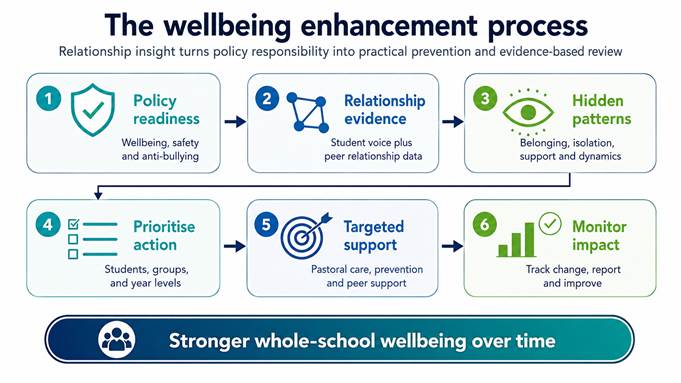
Figure 1. The wellbeing enhancement process: relationship insight turns policy responsibility into practical prevention and evidence-based review.
Why relationship insight adds value
Most school wellbeing data tells schools how individual students are doing. That is valuable, but incomplete. Relationship data adds a second layer: it helps schools understand the peer context around students and the group dynamics shaping everyday school culture.
For example, two students may report similar wellbeing concerns, but their relational situations may be very different. One may be socially isolated. Another may be connected to a group where negative influence is strong. Another may be a trusted support person for others but under pressure themselves.
By mapping peer-to-peer relationships alongside wellbeing indicators, schools can better understand hidden disconnection, peer support structures, informal student leadership, negative dynamics, and cohorts where belonging may need strengthening.
| The practical shift: from “Do we have a wellbeing policy?” to “Can we see where students are connected, isolated, supported or at risk?” |
How SNA Toolbox helps
SNA Toolbox helps schools combine student wellbeing data with peer relationship mapping to reveal patterns that are difficult to see from individual data alone. The aim is not to label students. The aim is to give approved school staff clearer insight so they can support students earlier, strengthen belonging and make wellbeing decisions with greater confidence.
Measure | Monitor | Support | Intervene |
| Student voice, wellbeing indicators and peer relationship nominations | Patterns across students, friendship groups, cohorts and year levels over time | Students who may be isolated, peripheral, unsupported or under relational pressure | Targeted individual, group, cohort or whole-school action, with follow-up evidence |
Practical implication
| Relationship insight is becoming essential infrastructure for whole-school wellbeing. It helps school leaders move from compliance confidence to prevention confidence: clearer priorities, earlier support, stronger evidence and better follow-up. |
CTA
Use this brief to review your school’s current wellbeing evidence: What can you already see, what remains hidden, and where could relationship insight help your team act earlier? To explore a pilot, visit www.snatoolbox.com.
References
1. Australian Government Department of Education. (2023). The Australian Student Wellbeing Framework. https://www.education.gov.au/student-resilience-and-wellbeing/australian-student-wellbeing-framework
2. Australian Government Department of Education. (2026). Implementation Plan for the Anti-Bullying Rapid Review. https://www.education.gov.au/antibullying-rapid-review/announcements/implementation-plan-antibullying-rapid-review
3. NSW Government / NESA. (2026). NSW Anti-Bullying Framework. https://www.nsw.gov.au/education-and-training/nesa/school-regulation/nsw-anti-bullying-framework
4. Victorian Government. (2026). Child safety and wellbeing policy. https://www.vic.gov.au/child-safety-and-wellbeing-policy
5. Australian Education Research Organisation. (2023). Encouraging a sense of belonging and connectedness in secondary schools. https://www.edresearch.edu.au/guides-resources/practice-guides/encouraging-belonging-and-connectedness-secondary
6. Korpershoek, H., Canrinus, E. T., Fokkens-Bruinsma, M., & de Boer, H. (2020). The relationships between school belonging and students’ motivational, social-emotional, behavioural, and academic outcomes in secondary education: a meta-analytic review. Research Papers in Education, 35(6), 641–680. https://doi.org/10.1080/02671522.2019.1615116
7. Centers for Disease Control and Prevention. (2024). School connectedness helps students thrive. https://www.cdc.gov/youth-behavior/school-connectedness/index.html
8. Truong, M., & Joshi, A. (2024). The influence of peer relationships in the middle years on mental health. Australian Institute of Family Studies. https://apo.org.au/node/325884
9. Department of Education and Youth, Ireland. (2025). School self-evaluation (SSE) six-step process. https://www.gov.ie/en/department-of-education/publications/school-self-evaluation-sse-six-step-process/
10. Welsh Government. (2026). Framework on embedding a whole-school approach to emotional and mental wellbeing. https://www.gov.wales/framework-embedding-whole-school-approach-emotional-and-mental-wellbeing
Note: This brief is provided for school planning and communication purposes and is not legal advice.
Transform Your Organisation with SNA Toolbox
Unlock insights into the key factors driving success and wellbeing in your organisation. Reach out to us at SNA Toolbox to explore how we can support and elevate your goals. Let's make an impact together!